

Many restaurants feel they could sell more private events, but don't know how much. The subject remains vague: “we receive a lot of requests”, “we should follow up better”, “the groups are interesting”.
To seriously manage this activity, we must transform this intuition into simple figures. The goal is not to build a complicated financial model, but to identify where the real leverage lies.
The basic formula
The potential revenue is simply calculated: number of qualified requests x conversion rate x average basket signed. This formula already gives a more useful view than a feeling.
Example: 40 qualified requests per month, 25% conversion, 3,000 CHF average basket. The signed monthly potential is 30,000 CHF.
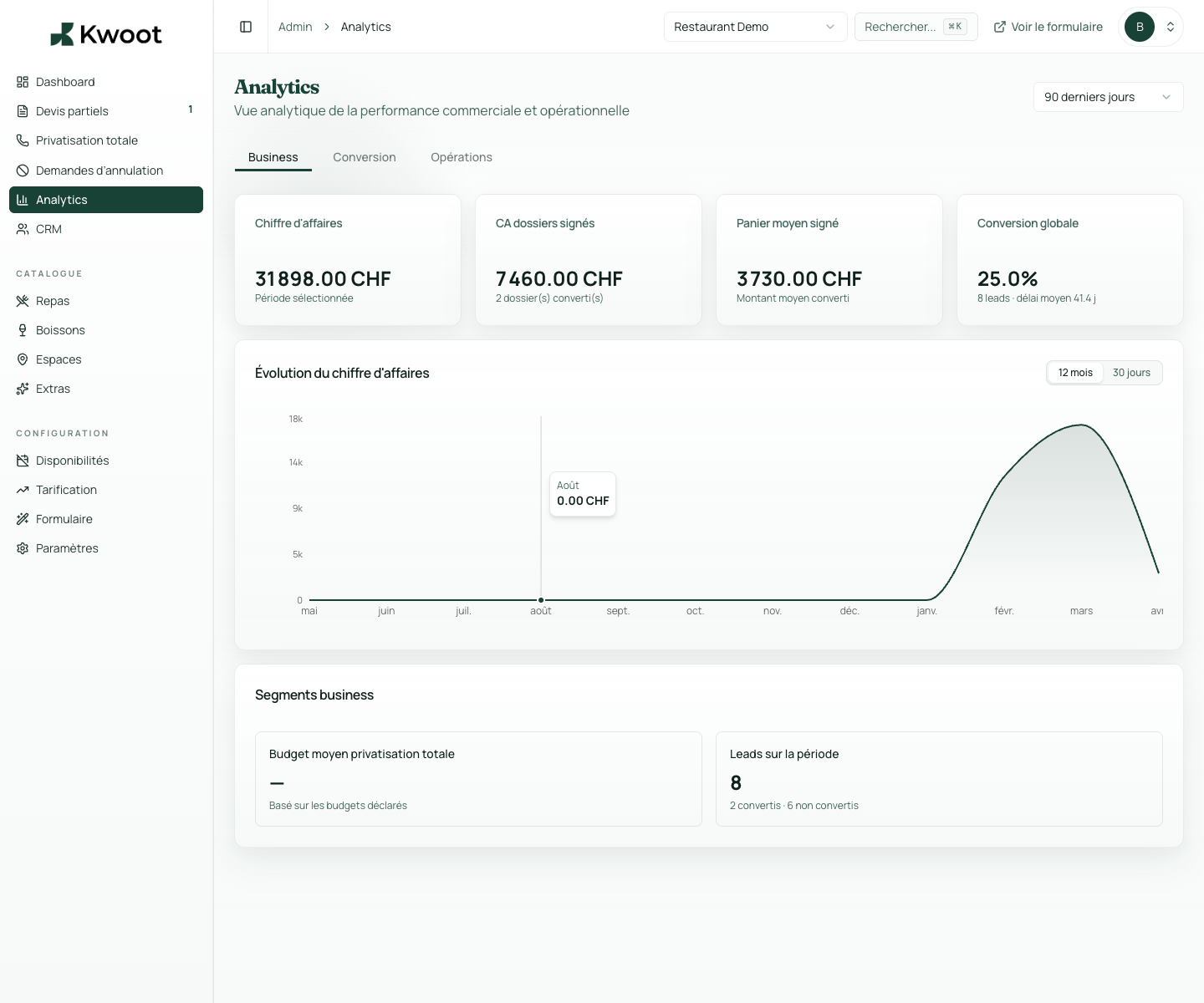
Separate raw requests from qualified requests
Not all requests are equal. A message without a date, without a number of participants and without a budget does not have the same weight as a company looking for a dinner for 60 people in three weeks.
Your conversion rate should be calculated on qualified requests. Otherwise, you risk underestimating the team's sales performance.
- Known date or period
- Realistic number of participants
- Clear format
- Budget consistent with your offer
- Usable contact details
Measure the average signed basket, not just the quote sent
The average useful basket is that of signed files. If you only look at the quotes sent, you may overestimate actual activity.
Also follow the difference between estimated quote and final amount. Changes in numbers, drinks and options can cause profitability to vary greatly.
Add available capacity
A restaurant may receive a lot of requests and not be able to serve them all. Event capacity depends on days, spaces, team and season.
Calculate the number of truly salable slots: lunches, off-duty evenings, private rooms, entire rooms. You will quickly see if the problem is acquisition, conversion or capacity.
Identify the most profitable lever
If you have few requests, the leverage is visibility. If you have a lot of quotes but few signatures, the lever is commercial follow-up. If you sign a lot but with a low basket, the leverage is the bid and the minimum spend.
The good dashboard is not there to impress. It is used to decide what to correct this week.
Transform the calculation into an action plan
Once the potential has been calculated, choose an action to test for a month. For example: responding to requests in less than 24 hours, putting a deadline on all quotes or adding a drinks option to cocktail offers.
Then measure the effect in a single number. If the signature rate increases, you know that the follow-up was the right lever. If the average basket goes up, the offer was probably too low.
- Objective of qualified applications
- Objective of quotes sent
- Goal of signed quotes
- Average basket goal
To remember
- Potential is calculated with qualified requests, conversion and average basket.
- The available capacity limits the achievable figure.
- Each number indicates a different lever: visibility, follow-up or offer.
Frequently asked questions
What conversion rate should you aim for?
It depends on the positioning and the volume of requests. The important thing is to measure your starting point, then improve the steps: response, quote, follow-up, signature.
Should Instagram and phone requests be counted?
Yes if they are qualified. The ideal is to centralize them so as not to underestimate your real volume.
How often to track these numbers?
Monthly tracking is enough for the strategy, but weekly tracking helps revive hot issues before they cool off.

