

An interested customer writes to the restaurant, gives some information, asks for a price, then disappears. Two weeks later, the team no longer knows if a quote was sent, if the deposit was requested or if the date can be relisted.
This scenario is common because the private event mixes several professions: sales, operations, administration and customer relations. Without a clear method, each request relies on the team's memory.
Mistake 1: responding without qualifying the request
Responding quickly is important, but responding without the right information creates a false start. If you do not know the date, the number of participants, the format, the schedule, the budget and the technical needs, you will produce a fragile quote.
The qualification should be short, but systematic. A well-designed form avoids three back and forths and gives the customer an impression of seriousness from the start.
Mistake 2: promising availability without blocking it
Saying “the room is available” without putting a deadline for confirmation is dangerous. The client thinks they have an option, the team thinks nothing is confirmed, and the date remains in a gray area.
Each proposal should have a validity period: for example 5 or 7 days. After this period, the date may be offered to another client.
Mistake 3: sending a quote that is too general
A quote that only says “group menu: 85 CHF per person” does not reassure enough. The customer should understand what is included, what is optional, what is estimated and what will be adjusted after confirming the final number.
A good quote answers questions before they arrive: times, reserved space, menu, drinks, deposit, balance, cancellation conditions, minimum number, maximum number.
Mistake 4: forgetting the deposit
Without a deposit, private event remains fragile. The restaurant blocks a date, prepares a file, sometimes refuses other requests, but the customer has not yet committed any money.
The deposit should be visible in the quote and easy to pay. The more effort the payment requires, the longer the confirmation takes.
Mistake 5: not keeping history
When a client returns six months later, the team should be able to find their last event: budget, preferences, final number, comments, signed documents. Without a history, you're starting from scratch and giving a less professional impression.
A centralized history also helps transmit the file if the person in charge is absent. Service continuity becomes much simpler.
The simple method to avoid these mistakes
You don’t need a huge internal manual to better manage private events. All it takes is a short routine: check new requests, complete missing information, send ready quotes, follow up on open files and check deposits.
This routine must be visible to the entire team. If only one person knows the status of each file, the risk returns as soon as they go on leave or a department becomes busy.
- A list of requests to be processed every morning
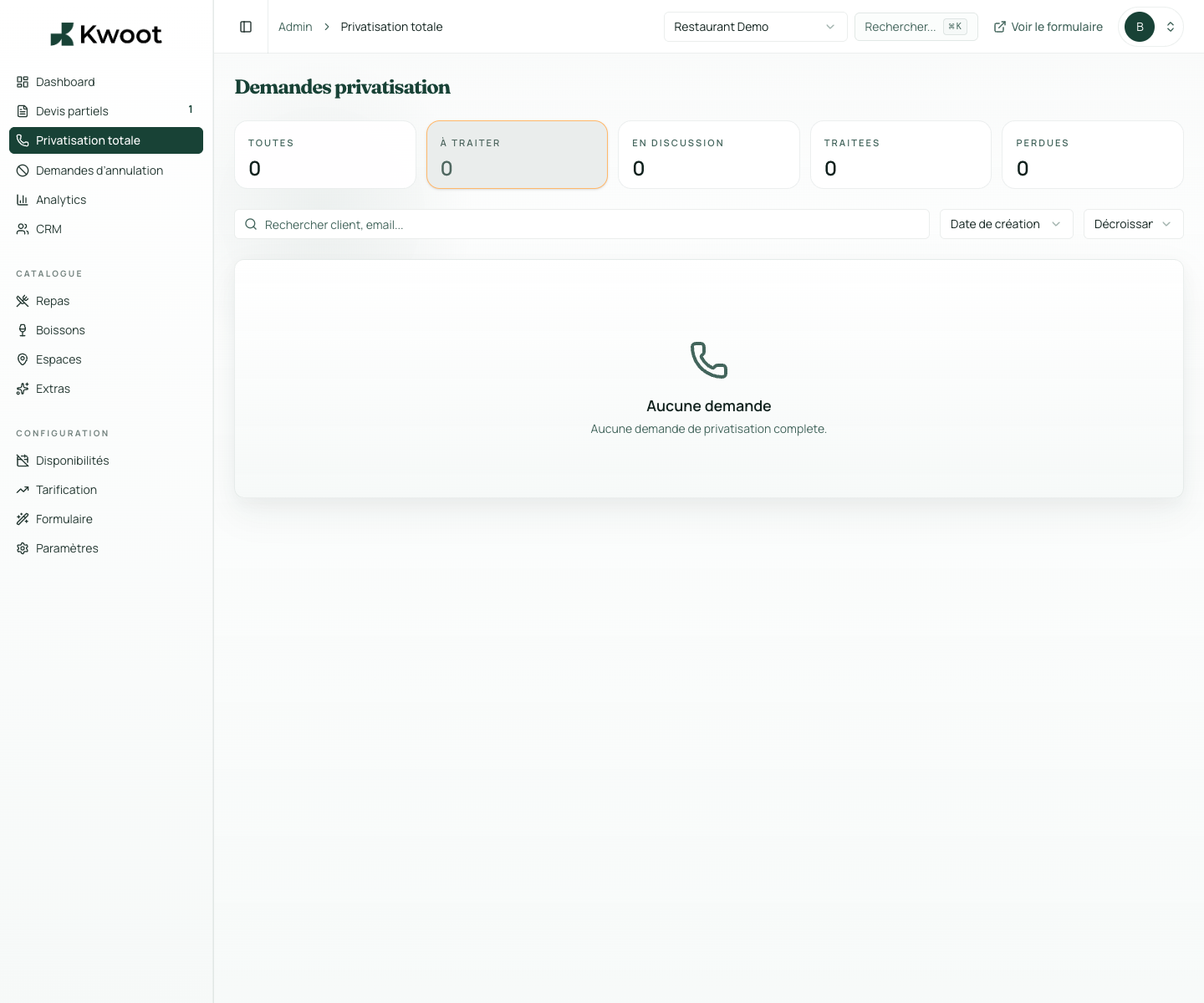
- Clear status for each file
- A deadline for each quote sent
- Weekly check of unsigned quotes
To remember
- Qualify each request before costing.
- Put a validity period on your proposals.
- Make the deposit simple to pay and easy to track.
Frequently asked questions
How much time should the customer have to validate a quote?
For a typical request, 5 to 7 days is often enough. For a large private event you can adapt, but the deadline must always be written.
Should we re-run all requests?
No. Above all, follow up on qualified requests: realistic date, coherent budget, sufficient number of participants and real need expressed.
What is the first process to put in place?
Start with a complete request form and a clear status for each file: new, quote sent, relaunched, signed, deposit paid, lost.

