

The quote is gone. The customer responded “thanks, I’ll look with my team”. Then nothing more. This phrase is one of the great classics of restaurant private events.
Before concluding that the customer is not serious, you must look at the quote as a decision-making tool. Is it clear? Does he reassure? Does it say exactly how to confirm? Does he make you want to sign now rather than later?
The customer did not understand what is included
Price alone is not enough. If the customer does not see the difference between menu, drinks, space, service, options and possible costs, he will ask to think about it or compare with a cheaper but less complete proposal.
The quote must make the offer readable in a few seconds. An internal decision-maker must be able to transfer it to his team without having to re-explain the entire exchange.
- A clear title for the event
- The number of participants used for the calculation
- Services included and options
- The deposit, the balance and the deadlines
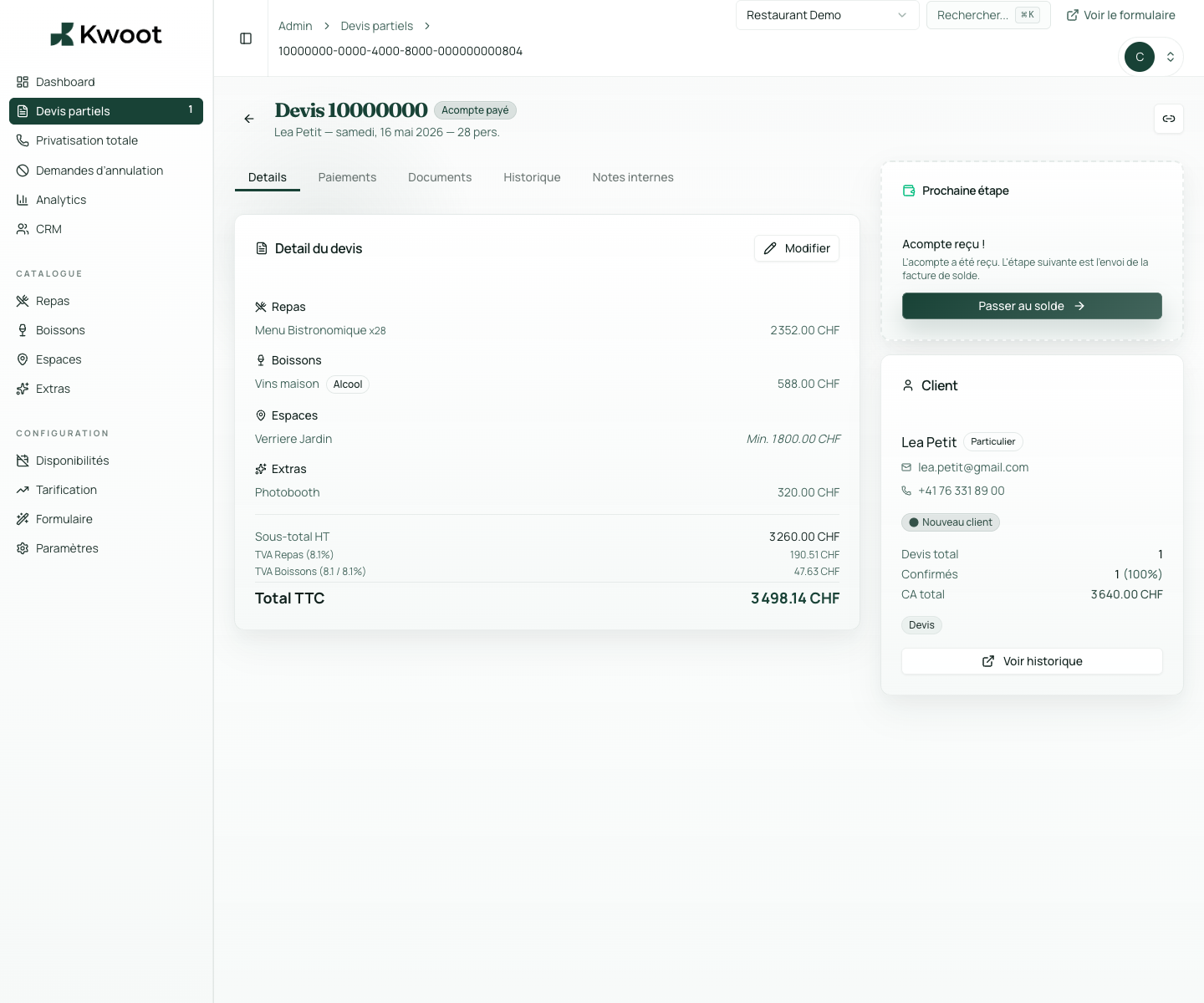
The amount seems high because the value is not visible
A customer rarely compares two quotes line by line. It compares a feeling of value. If your quote does not show the level of service, private event of space, coordination and operational flexibility, the price seems isolated.
Add concrete details: type of space, duration of availability, dedicated team, possible customization, allergy care, timing management.
There is no real urgency
Without a deadline, the customer can postpone his decision. He doesn't necessarily intend to give up, but your proposal moves down his list of priorities.
The deadline should be polite and clear: “This quote is valid until May 12. After this deadline, we can no longer guarantee space availability.”
Signing requires too much effort
Download a PDF, print it, sign it, scan it, send it back, then request a RIB for the deposit: each step adds time. Even a motivated customer can postpone.
The ideal path involves two actions: signing online and paying the deposit. The more the customer can do this from their phone, the faster the confirmation arrives.
The recovery talks about the restaurant instead of helping the customer
“Have you had time to look at our quote?” is correct, but weak. A good reminder helps the customer decide: it reminds the date, format, availability, budget and action to be taken.
The follow-up should be short, useful and confirmation-oriented. The tone remains professional, without unnecessary pressure.
Make the quote easy to defend internally
In a company, the person who requests the quote is not always the one who validates it. She often has to pass it on to a manager, human resources or finance. If the document does not clearly explain the choice, it remains blocked.
So add a summary at the top of the page: event objective, date, space, number of participants, total budget, deposit and next step. This block helps your contact get an agreement without asking you three times.
- Summary of the file in 5 lines
- Total amount and deposit separate
- Validation deadline
- Important conditions readable without searching
To remember
- A quote should help the customer decide, not just present a price.
- The expiration date reduces cases that remain open too long.
- Online signature and simple deposit speed up confirmation.
Frequently asked questions
Should I call the customer after sending the quote?
Yes for large files or highly requested dates. A short call allows objections to be resolved more quickly than a series of emails.
When to follow up on a sent quote?
A first reminder 48 hours after sending works well. Then, follow up before the expiration date, then close properly if the customer doesn't respond.
Do we have to make a discount to obtain the signature?
Not by reflex. First clarify the value, scope and options. If the budget is really tight, adjust the offer rather than slashing the price.

