

For a restaurant, electronic signature is not only a convenience. It reduces the time between “the quote suits me” and “the date is really confirmed”.
This guide provides practical guidelines for private event quotes in Switzerland and France. It does not replace legal advice, but it helps to structure a serious and workable signature process.
What the signature must prove
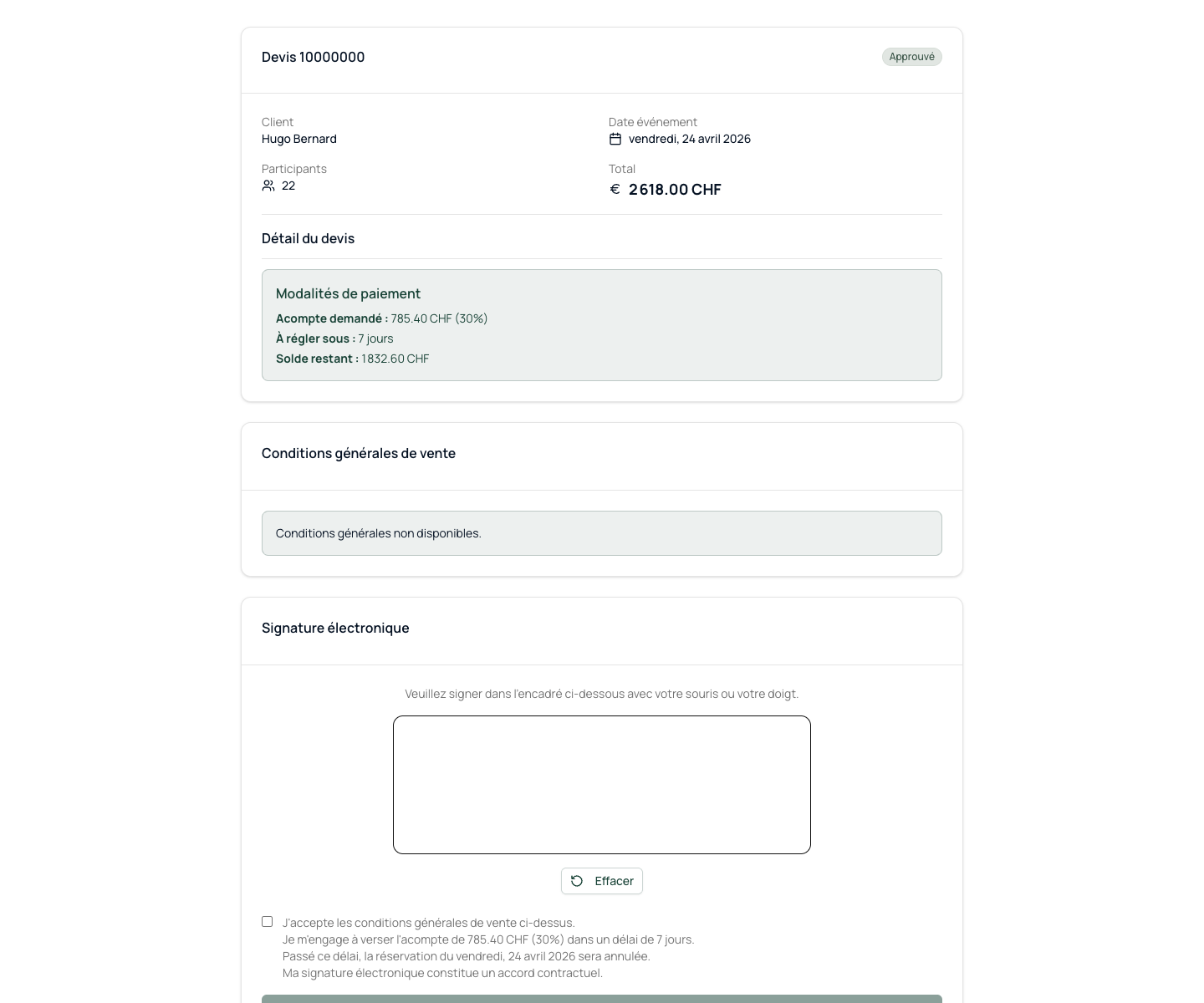
In a private event quote, the subject is not just the image of a signature. The restaurant must be able to show that the customer accepted a specific offer, on a specific date, with specific conditions.
A serious process therefore preserves the signed document, the date, the identity of the signatory, the amount, the conditions accepted and the status of the requested payment.
- Complete document at the time of signing
- Validation date and time
- Identity or contact details of the signatory
- Payment and cancellation conditions visible
In France: electronic writing is common, but proof counts
In France, electronic writing is widely accepted in commercial exchanges, provided that you can identify the person accepting and keep the document in good condition.
For a restaurant, the best practice is simple: don’t settle for an “OK for me” email. Have a complete quote or conditions attached to the quote signed, then keep the file.
In Switzerland: traceability remains the central point
In Switzerland, electronic exchanges are also used in commercial relations. For private events, the practical challenge is to prove the agreement: who accepted, what, when, and on what conditions.
If your restaurant works with companies, the clarity of the document is as important as the signature: billing address, VAT, deposit, deadlines, cancellation conditions and final number must be explicit.
The signed quote must be linked to the deposit
A signature without a deposit can leave a fragile file. The customer accepted, but the restaurant has not yet received payment. For the requested dates, signature and deposit must be reconciled.
The most effective is to present the two actions in the same process: sign, then pay the deposit from the same customer file.
What to avoid
Avoid quotes modified after signature without new validation. Also avoid conditions sent in a separate email that the customer may not read.
The signed document must be the reference. If a condition is important to the restaurant, it must appear in the quote or in conditions clearly attached to the quote.
Prepare easy-to-find proof
The day a customer disputes a condition, your team must find the right document without digging through an email box. The signed quote, conditions, payment and important exchanges must be attached to the same file.
This organization also protects the service. The person hosting the group knows which document is authentic, what deposit has been paid and what conditions have been accepted.
- Signed version of the quote
- Conditions accepted at the same time
- Trace of payment or deposit
- History of changes after signature
To remember
- The signature must be linked to a complete and dated document.
- Keep the proof: signatory, date, conditions, amount, payment.
- Signature and deposit in the same process reduce blocked files.
Frequently asked questions
Is a “good for agreement” email enough?
It can help prove an intention, but it remains less clean than a signed quote with conditions and trace of validation. For private event, it is better to formalize it.
Is an advanced electronic signature required?
Not necessarily for all restaurant quotes. The expected level depends on the risk, amount and context. The key point is to keep clear proof of the agreement.
Can we modify a signed quote?
Yes, but the new version or amendment must be validated. The customer must know precisely what is changing.

